

We’re letting you know that this post contains sponsored links which Your Savvy Purse receives compensation for, which may impact their order of appearance.
For the past several years, our collective relationship with downtime has followed a highly accelerated, screen-heavy formula. After spending eight to nine hours managing digital workflows, answering emails, and navigating video calls at work, we transition into our evening leisure hours by sliding right back onto our personal devices. We scroll through short-form video feeds, stream high-production television series, or browse digital marketplaces. We market this to ourselves as ultimate relaxation—a frictionless way to decompress after a demanding day.
But if we look closely at how our brains feel after an evening of passive digital consumption, a frustrating reality sets in.
Instead of feeling fully rested, mentally clear, and deeply rejuvenated, we often wake up the next morning experiencing a low-grade baseline of cognitive fatigue, a shortened attention span, and a quiet sense of creative emptiness. Passive consumption does not restore our mental bandwidth; it simply numbs it.
Our working memory is continuously overstimulated by blue light and algorithmic inputs, leaving our central nervous systems stuck in a state of fractured focus.
True lifestyle resourcefulness means breaking away from this passive loop and reclaiming your free time through an active, tactile medium: The Creative Hobby.
Engaging in a hands-on, artistic outlet is not a frivolous waste of time or a luxury reserved only for naturally gifted artists. It is a profound act of cognitive decompression and structural self-care.
When you introduce your hands to a physical craft—whether you are shaping clay, carving wood, arranging flora, or mixing raw pigments—you alter your brain chemistry.
You step out of the frantic, metric-driven pace of modern life and slip into a deeply restorative psychological state known as flow.
The goal isn’t to build a flawless, museum-quality product to sell or show off online; it is to enjoy the rhythmic, low-stress process of building something tangible out of raw elements.
This comprehensive guide profiles four elite, beginner-friendly creative hobbies designed to restore your mental focus, lower your daily stress hormones, and inject a massive shot of inspiration into your week.
1. The Neurobiology of Creative Flow: Why Your Brain Craves Tactile Making
To successfully integrate a creative hobby into your busy adult schedule, you must first throw away the toxic perfectionism that dictates every activity must be optimized for a side-hustle or a public platform. The true ROI of an artistic hobby is entirely psychological and neurological.
When you engage in a repetitive, focused physical craft, your brain waves slow down from the high-frequency, analytical beta state into the calm, deeply creative alpha and theta wave states.
This shift triggers a synchronized release of dopamine, endorphins, and serotonin—the exact neurochemical cocktail responsible for mood elevation, enhanced problem-solving capacity, and lowered systemic cortisol levels.
Psychologists call this “optimal experience” or “the flow zone.” It acts as a powerful cognitive reset mechanism. Because your working memory is entirely anchored to the weight of a chisel, the texture of a textile, or the placement of a brushstroke, your brain completely silences the default mode network—the neural pathway responsible for anxious overthinking, workday rumination, and stress.
Making beautiful things with your hands is a mechanical antidote to modern screen fatigue.
2. Four Elite Creative Hobbies to Start This Season
These four targeted hobbies are selected specifically because they feature a low financial barrier to entry, require no complex machinery, and allow you to explore a variety of artistic textures right at your kitchen table.
Hobby 1: Linocut Block Printing (The Ultimate Textural Graphic Craft)
If you crave the visual reward of graphic design and clean typography but want to step completely away from computer monitors and drawing tablets, block printing is an absolute home run.
- The Creative Mechanism: You transfer a simple sketch onto a small, soft linoleum or rubber block, use a specialized hand-gouging tool to carve away the negative space, roll a layer of rich ink across the raised surface, and press it firmly onto paper or fabric to reveal a bold, high-contrast print.
- Why It Calms the Mind: The physical act of gouging out the rubber requires slow, controlled upper-body focus. Your ears tune into the rhythmic, crisp slicing sound of the tool against the block, creating an instant sensory anchor. The results are incredibly versatile—you can use your custom-carved stamps to design personalized greeting cards, create custom textile prints on canvas tote bags, or build a stunning gallery wall of abstract art prints for your home.
Hobby 2: Modern Punch Needle Rug Hooking (The Soft, Rhythmic Textile Sanctuary)
Traditional knitting and embroidery are classic fiber arts, but they often require tedious pattern-counting and micro-precision that can strain your eyes after a long day of reading text on screens. Punch needle art simplifies the process into a fluid, highly intuitive textile playground.
- The Creative Mechanism: Using a hollow, specialized punch needle tool threaded with thick, chunky yarn, you repeatedly pierce a stretched piece of monk’s cloth canvas from the back. Every single punch pushes a clean loop of yarn through to the front side of the fabric, creating a rich, dense, and deeply textured pile that looks like a miniature tufted rug.
- Why It Calms the Mind: Punch needle is an incredibly forgiving and rapid craft. There are no complex stitches to memorize or drop-stitch mistakes that can ruin your entire progress. The repetitive, physical motion of punching the needle through the tight woven canvas creates a soothing rhythm that acts as a moving meditation. You can use this vibrant medium to create plush, geometric beverage coasters, abstract throw pillow covers, or tactile wall tapestries that bring warmth and texture into your living spaces.
Hobby 3: Tabletop Hand-Building Pottery (The Grounding Earth Element)
Working with clay is an ancient human tradition that grounds our nervous system far better than almost any other medium. If you don’t have access to a local studio or a heavy motorized pottery wheel, hand-building allows you to explore ceramics completely from your own countertop.
- The Creative Mechanism: Using air-dry clay or oven-bake stoneware, you master three fundamental, low-stress manual techniques: pinching (shaping a hollow vessel from a solid ball of clay), coiling (stacking thin ropes of clay to build height), or slab-building (joining flat sheets of clay to build crisp geometric shapes).
- Why It Calms the Mind: Clay is an intensely tactile, responsive material. It responds instantly to the exact pressure, moisture, and warmth of your fingertips, forcing your brain to remain entirely present in the moment. Shaping the cold, wet earth helps regulate your breathing, improves fine motor dexterity, and allows you to craft gorgeous, functional home accents—such as minimalist incense holders, organic wavy trinket dishes, or rustic textured bud vases—with zero complex machinery required.
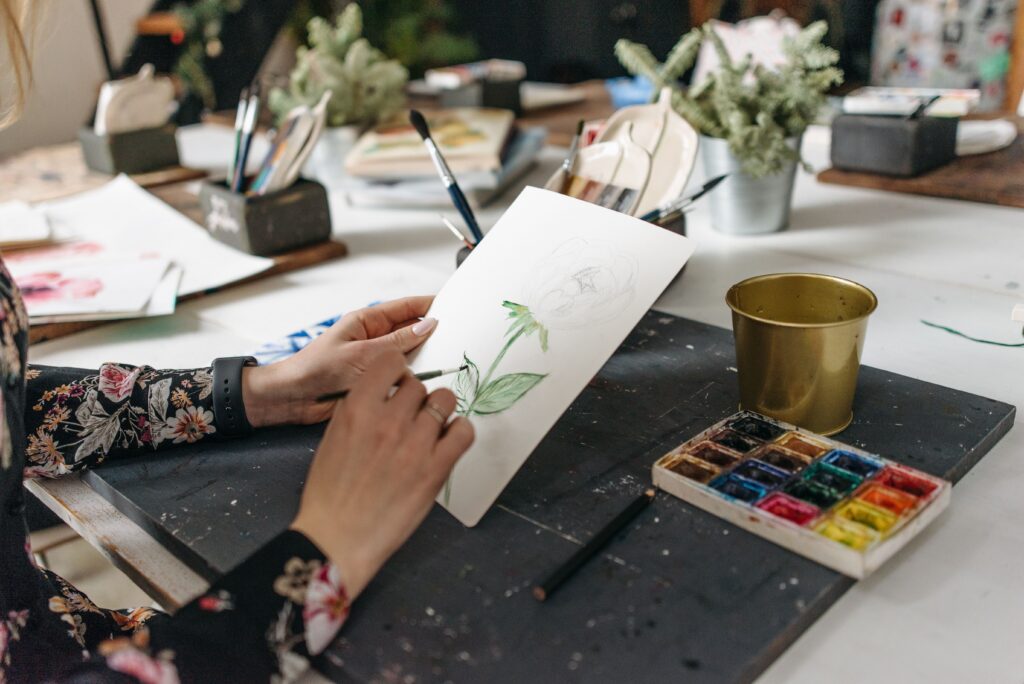
Hobby 4: Botanical Watercolor and Gouache Painting (The Fluid Color Study)
For many adults, picking up a paintbrush triggers immediate performance anxiety because we assume we have to paint a realistic, flawless landscape or portrait. Botanical color studies completely remove this creative pressure.
- The Creative Mechanism: Using heavy, cold-press watercolor paper and a starter palette of rich gouache or watercolor paints, you focus entirely on the fluid interplay of color, water, and simple leaf silhouettes. You practice blending deep forest greens, warm ochres, and soft terracotta shades, laying down basic leaf strokes, delicate stems, and simple floral washes.
- Why It Calms the Mind: Watercolor painting is a fascinating lesson in letting go of control. Because the pigments naturally bleed, shift, and blend across the wet paper on their own terms, you cannot micromanage the outcome. You are forced to cooperate with the medium, watching the colors diffuse into unique patterns, which lowers your baseline stress levels and fosters an appreciation for beautiful imperfections.
The Creative Hobby Operational Matrix
To help you seamlessly select the correct artistic outlet for your current mental energy and living space setup, utilize this scannable verification layout:
| Creative Hobby Option | Core Sensory Experience | Initial Equipment Footprint | The Ultimate Creative Output |
| Linocut Block Printing | Structured, crisp, and mechanical. | Small (Carving tool, ink roller, rubber blocks). | Custom stamped stationery, wall art prints, and custom fabrics. |
| Punch Needle Art | Soft, rhythmic, and highly forgiving. | Medium (Yarn bundles, punch needle, canvas frame). | Plush geometric coasters, throw pillow covers, and textured tapestries. |
| Tabletop Hand-Pottery | Earthy, wet, and deeply grounding. | Small (Air-dry clay block, basic wooden scraping tools). | Minimalist incense holders, trinket trays, and rustic bud vases. |
| Botanical Painting | Fluid, peaceful, and color-focused. | Exceptionally Low (Watercolor pan, 2 brushes, paper pad). | Serene botanical wall art, gift tags, and custom matting. |
Final Thoughts
Embracing an active, creative hobby is one of the highest-yielding acts of mental self-care and lifestyle resourcefulness you can practice. It is a powerful daily declaration that your precious free time is a valuable commodity that deserves to be spent on self-discovery, play, and tangible creation rather than being passively traded away to digital algorithms. True tranquility is born when we grant ourselves permission to be complete beginners, to make messes, and to enjoy the process of building things completely for its own sake.
By setting up a clean drop cloth on your kitchen table and investing in a simple, low-friction starter kit, you create an intentional sanctuary away from the stress of modern life.
You rescue your attention span from digital clutter, re-energize your creative spirit, and enjoy the effortless focus and absolute peace that comes with crafting your own beautiful world, entirely on your own terms.